Speech Recognition System for Sinhala
Name of the Researcher(s)
- Dr. A.R. Weerasinghe
- Thilini Nadungodage
- Randil Pushpananda
- Chamila Liyanage
Description
The main goal of this project is to enhance human-computer interaction by developing an Automatic Speech Recognition (ASR) engine that enables users to access computers and other digital devices using the Sinhala language. An ASR system capable of automatically digitizing continuous free flowing natural voices enables users to interact with such digital devices more naturally.
An ASR system can be considered as a much more natural interface than the present key-board or touch screen. It is a more inclusive interface to digital content since it can also be accessed easily by senior and/or physically impaired citizens who are unable to or has difficulties with the use of present day input devices for using computers. A relatively accurate ASR system can also be used in value added applications such as dictation systems, dialog systems and other computer and mobile applications.
After several decades of its initiation ASR research has been able to provide promising results of progress. Currently, considerable advances have been made in some limited application areas.
However, most of the advances in this field have been limited to a certain number of languages. They have been built for languages for which large collections of speech are available. English and many of the European languages have decades of ASR research based on such large speech and text collections funded by US and European governments and other funding sources. Recently, Chinese and Arabic ASR have also seen rapid development with generous amounts of funding poured in.
However, languages spoken by relatively small
populations and mostly in the developing regions of the world haven’t been funded to create the necessary resources and tools to enable ASR systems to be built for them.
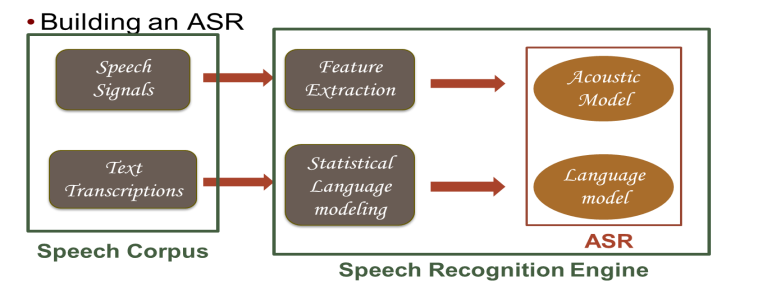
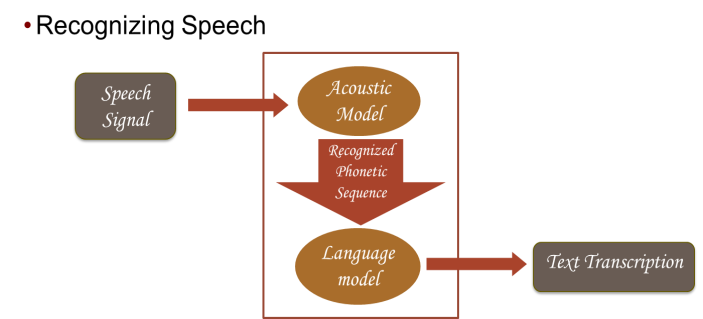
An Automatic Speech Recognizer or a Speech-To-Text system is a computer based system capable of converting human speech into computer readable form (e.g. digitized text). The conversion of speech to text involves many important processes. These processes can be divided mainly in to two categories; acoustic modeling and language modeling.
An acoustic model is used in Automatic Speech Recognition to represent the relationship between an audio signal and the phonemes (or other linguistic units) that make up speech. The model is learned from a set of audio recordings and their corresponding manually annotated transcripts. It is created by taking audio recordings of speech and their transcriptions and then compiling them into statistical representations of the sounds which make up words.
The language model is responsible for modeling such sequences of sounds and words in order to predict the most likely utterance that was made. The language model provides context to distinguish between words and phrases that sound similar.
The most difficult problem one has to solve when starting to build an ASR system from scratch is the problem of creating a good training data set. The type of data set needed for speech recognition is a Speech Corpus. A speech corpus is a combination of recorded speech (Acoustic data) and their corresponding transcriptions (Labels). When building a speech corpus, acquiring raw acoustic data is not a very difficult task. However, the hard part is labeling them appropriately.
In this project we intend to collect voice samples from 400 speakers of different ages, genders, and from different areas of the country. The speakers are prompted to read out a pre-selected set of sentences which will cover most of the speech sounds in the Sinhala language.
Description
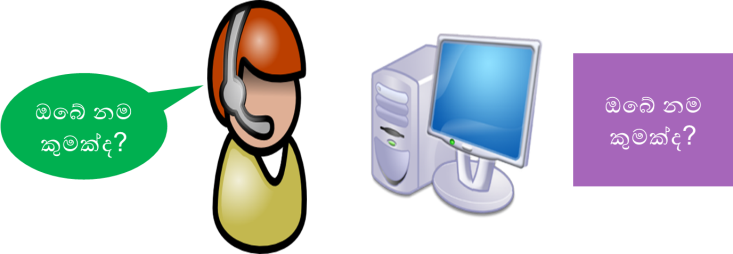
Sinhala Speech Recognition
ASR Building Process
ASR Recognition Process
Contact details of the researcher(s)
- Dr. A.R.Weerasinghe Email: arw@ucsc.cmb.ac.lk
- Thilini Nadungodage Email: hnd@ucsc.cmb.ac.lk
- Randil Pushpananda Email: rpn@ucsc.cmb.ac.lk
- Chamila Liyanage Email: cml@ucsc.cmb.ac.lk
Publication
- Thilini Nadungodage, Ruvan Weerasinghe, and Mahesan Niranjan (2013). “Efficient use of training data for sinhala speech recognition using active learning.” Advances in ICT for Emerging Regions (ICTer), 2013 International Conference on. IEEE, 2013.
- Thilini Nadungodage, Viraj Welgama, Ruvan Weerasinghe (2013). “Developing a Speech Corpus for Sinhala Speech Recognition”. 10th International Conference on Natural Language Processing. CDAC, NOIDA, India, 18-20 December 2013.
- Thilini Nadungodage, Ruvan Weerasinghe, and Mahesan Niranjan (2015). “Speaker Adaptation Applied to Sinhala Speech Recognition”. Selected for publication in a special issue of the journal Research in Computing Science.
- Thilini Nadungodage, Ruvan Weerasinghe, and Mahesan Niranjan. “Application of Two Active Learning Methods in the Domain of Speech Recognition”. Submitted to the Computer Speech and Language Journal (Under Review).