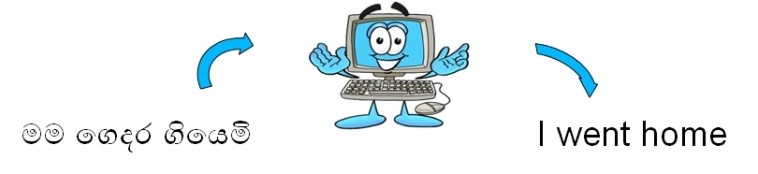
Machine Translation System for Sinhala -Tamil Language Pair
Name of the Researcher(s)
- Dr. A.R. Weerasinghe
- Randil Pushpananda
- Thilini Nadungodage
- Chamila Liyanage
Description
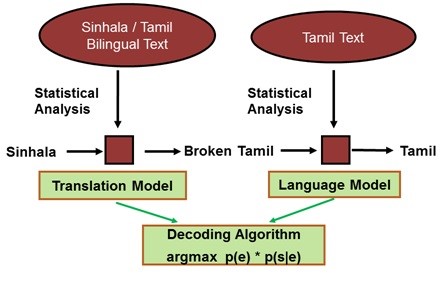
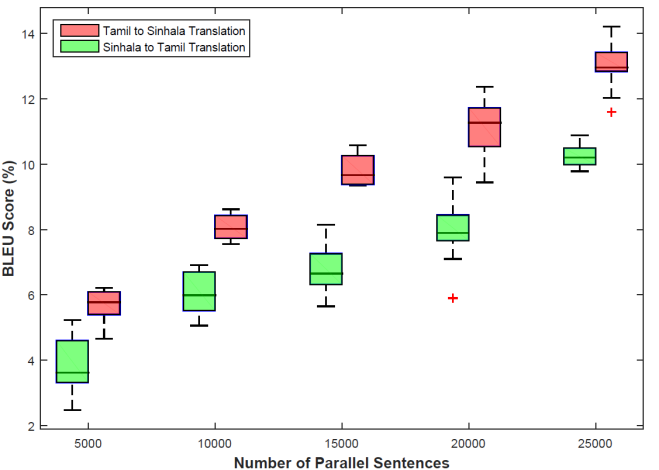
One of the long standing national issues in Sri Lanka stems from the fact that the two main people groups are conceptually isolated by the language barrier which keeps Sinhala speakers apart from Tamil speakers. While a few attempts using ‘toy’ systems have been developed in the past, an acceptable level automatic machine translation system in both directions (Sinhala to Tamil and Tamil to Sinhala) has so far not been developed. These reasons motivated us to develop a machine translation system for languages with limited text resources and morphologically rich: Sinhala and Tamil. Machine translation is an intellectually challenging branch of artificial intelligence which involves automatically translating from one natural language to another using a computer. Currently, statistical machine translation approach is the most successful approach in machine translation world. However, still there is very limited research on languages which are both morphologically rich and low resourced. According to literature, morphologically rich and low resourced language pairs can benefit from integrating linguistic information in to the machine translation process. However, no such research integrating linguistic information to machine translation has been conducted for the Sinhala-Tamil language pair. The main reasons for this include the unavailability of adequate quantities of parallel data, the lack of knowledge in complex morphology and syntax, the unavailability of part-of-speech taggers and morphological analyzers for Sinhala and Tamil languages and the fact that Sinhala is only mainly spoken in Sri Lanka. In this research, we integrate linguistic information to the machine translation process to supplement surface level word forms. Since there are no proper part of speech taggers and morphological analyzers available for both Sinhala and Tamil languages, we explore new approaches to mitigate the out-of-vocabulary problem which affects most parallel datasets. In this research, we expect to find a suitable approach to develop an acceptable level machine translation system for Sinhala-Tamil language translation by compiling an adequate collection of example translations (parallel text).
Related Images
Contact details of the researcher(s)
- Dr. A.R.Weerasinghe Email: arw@ucsc.cmb.ac.lk
- Randil Pushpananda Email: rpn@ucsc.cmb.ac.lk
- Thilini Nadungodage Email: hnd@ucsc.cmb.ac.lk
- Chamila Liyanage Email: cml@ucsc.cmb.ac.lk
Publication
- Pushpananda, R., Weerasinghe, R., and Niranjan, M. (2015). Statistical machine translation from and into morphologically rich and low resourced languages. In Computational Linguistics and Intelligent Text Processing – 16th International Conference,CICLing 2015, Cairo, Egypt, April 14-20, 2015, Proceedings, Part I, pages 545-556.
- Pushpananda, Randil, Ruvan Weerasinghe, and Mahesan Niranjan. ”Sinhala-Tamil Machine Translation: Towards better Translation Quality.” Australasian Language Technology Association Workshop 2014. Vol. 129. 2014.
- Pushpananda, Randil, Ruvan Weerasinghe, and Mahesan Niranjan. ”Towards Sinhala Tamil machine translation.” Advances in ICT for Emerging Regions (ICTer), 2013 International Conference on. IEEE, 2013.
(Currently, prototype of Sinhala to Tamil and Tamil to Sinhala machine translation system is available at the URL: translate.subasa.lk)