Programme at a Glance
PROGRAMME
Master
SLQF LEVEL
SLQF 9

Two (2) Academic Years (4 Semesters), Part-time
Note: This description applies to the MIT student intake from 2024/25 onward (By-Laws 2025). Click here to view the description for previous intakes.
Please note that this information is for general reference only and may not fully reflect the official By-Laws and Regulations. Candidates seeking detailed information about the program are advised to review the relevant By-Laws and Regulations and contact the appropriate authority if necessary.
Introduction
The Master of Information Technology (MIT) degree program is tailored for non-computing graduates and individuals with limited computing experience who are eager to build a career in the IT industry. This program is well-suited for school teachers, government employees, freelancers, and other professionals aiming to advance their careers in IT.
Our curriculum spans a broad array of IT fields, including programming, software engineering, quality assurance, web and mobile development, artificial intelligence, data security, UI/UX design, and more. The program includes an Independent Study, enabling you to dive deeply into a chosen area of interest under the guidance of an expert supervisor.
Graduates are prepared for a wide range of IT roles, from software and web development to quality assurance, network administration, database management, data analysis, UI/UX design, IT management, and freelancing. With this MIT degree, you’ll gain the knowledge and skills needed to thrive in the ever-evolving world of information technology.

Lectures and Practicals
Weekends 8.30 am – 5.45 pm.
Entry qualification
No person shall be eligible to be admitted to the Programme unless such person satisfies the following minimum requirements :
a) A Bachelor’s Degree from a University or Institution recognized by the University Grants Commission and/or the University of Colombo;
Or
b) Any other academic or professional qualification deemed equivalent to a Bachelor’s Degree by the Senate of the University of Colombo on the recommendation of the School. Provided that, each such application under this category shall be considered on a case-by-case basis.
Admission
The applicants who possess the entry qualification shall sit for a selection test (GCAT, https://gcat.ucsc.cmb.ac.lk/), and the short-listed candidates from the selection test shall face an interview in order to be selected to the programme.
Course Fee
The course fee is categorized into three types: local, foreign SAARC countries, and foreign non-SAARC countries.
Local Students: Rs. 345,000/=
Foreign SAARC Students: US$ 2700
Foreign Non-SAARC Students: US$ 3300
Note: Students are required to pay the full course fee for the degree at the time of initial registration.
A student whose initial registration has lapsed shall pay a renewal fee to extend the registration period and pay relevant fees for repeat examinations. Eligibility for re-registration is subject to the provisions outlined in the relevant By-Laws and Regulations.
Award of the MIT Degree
(1) The minimum conditions which a student shall satisfy for the award of the Master of Information Technology shall be as follows :-
(a) obtained not lower than C grade (GPV of 2.00) in the Courses which make up a minimum of 30 Credits;
(b) obtained not less than a GPA of 2.00 for all the Courses which make up a minimum of 40 Credits; and
(c) obtained not less than a C Grade (Pass) for the Independent Study.
(2) Once the relevant Board of Study has decided to award the Degree, the student is no longer eligible to continue the Programme, and all pending results shall be rendered null and void.
(3) No student shall be entitled to the award of the Master of Information Technology unless such student has satisfied all other relevant requirements and such student has supplicated for the award of the Master’s Degree at the relevant Convocation of the University.
Program Structure
The program consists of multiple courses, each carrying a specified number of credits. All courses in the first and second semesters are compulsory, while the third and fourth semesters include both compulsory and optional courses. Module descriptors for each course are available on PGVLE. To obtain the degree, students must complete the required courses and meet the minimum conditions outlined in the relevant By-Laws and Regulations.
The Course Codes, Titles, Credits and their Standing in each Semester are as follows:
First Semester Courses
| Code | Title | Credits | Standing |
| MIT1301 | Program Design and Programming | 3 | C |
| MIT1302 | Computer Systems | 2 | C |
| MIT1303 | Database Management Systems | 3 | C |
| MIT1304 | Data Communications and Computer Networks | 3 | C |
| MIT1305 | Mathematics and Statistics for IT | 2 | C |
Second Semester Courses
| Code | Title | Credits | Standing |
| MIT2301 | Software Engineering | 2 | C |
| MIT2302 | Data and Network Security | 2 | C |
| MIT2303 | UI/UX Design | 2 | C |
| MIT2304 | Web and Mobile Development | 3 | C |
| MIT2305 | Artificial Intelligence | 3 | C |
Third Semester Courses
| Code | Title | Credits | Standing |
| MIT3301 | IT Project Management and Professional Issues | 2 | C |
| MIT3302 | Platform Technologies | 2 | C |
| MIT3303 | E-Learning Concepts and Technologies | 2 | O |
| MIT3304 | Data Mining for Business Intelligence | 2 | O |
Fourth Semester Courses
| Code | Title | Credits | Standing |
| MIT4301 | Independent Study | 5 | C |
| MIT4302 | Software Quality Assurance | 2 | C |
| MIT4303 | e-Business Applications and Strategies | 2 | O |
| MIT4304 | Multimedia and Graphic Design | 2 | O |
C – Compulsory (Core) Course | O – Optional (Elective) Course
Note: The Senate shall, on the recommendation of the Academic Syndicate, have the power to make changes to the list of Courses, Course Codes, Course Titles (Name), Level & Semester, and Number of Credits (Credit Values) and whether Compulsory or Optional.
The detailed syllabus applicable to the Courses shall be as prescribed from time-to-time as approved by the Academic Syndicate.
Each Credit Value shall correspond to different quantum of hours depending on the type of learning activities as specified in the following table:
| Course Description | Credit Value | Direct Staff-Student Contact Hours | Notional Hours (direct staff-student contact hours and independent learning) |
| Lecture Course | 1 | 15 | 50 |
| Laboratory Course | 1 | 30 | 50 |
| Independent Studies | 5 | Variable | 500 |
Grading System and Calculation of Grade Point Average (GPA)
The Range of Marks and the corresponding Grades and Grade Point Values (GPV) shall be those given in the following table:
| Range of Marks | Grades | Grade Point Values (GPV) |
| 90–100 | A+ | 4.25 |
| 80–89 | A | 4.00 |
| 75–79 | A- | 3.75 |
| 70–74 | B+ | 3.25 |
| 65–69 | B | 3.00 |
| 60–64 | B- | 2.75 |
| 55–59 | C+ | 2.25 |
| 50–54 | C | 2.00 |
| 45–49 | C- | 1.75 |
| 40–44 | D+ | 1.25 |
| 30–39 | D | 1.00 |
| 20–29 | D- | 0.75 |
| 0-19 | E | 0.00 |
| 0 | NC, CN | 0.00 |
NC – Not Complete, CN – Canceled
Note :- The examination branch of the School may use additional status codes such as NA (Not Applicable), WH (Withheld), and AB (Absent) to represent the intermediate status of student results.
If the Grade Point Average (GPA) of a student is required for any purpose, it shall be calculated using the following equation:
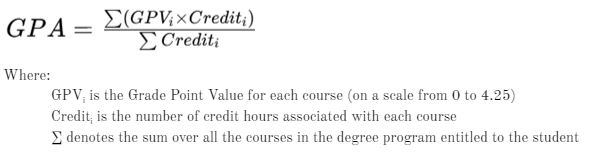
The GPA is rounded to the second decimal place.
If a student has registered for more Elective courses than required, regardless of whether this exceeds the minimum number of credits needed, all such courses shall be included in the GPA calculation for that student.
Any student who has not appeared for the evaluation of a Course may be assigned a GPV of 0.00 for such Course for the purpose of calculating the GPA of such student.
Course Overview
Below is a brief description of each course.
Semester 1
This course introduces the fundamentals of program design and programming, focusing on the Python programming language. It aims to equip students with essential programming skills and a strong foundation in problem-solving techniques, enabling them to tackle computational tasks across various domains. The course begins with an introduction to programming concepts and Python syntax, progressing through more complex topics like object-oriented programming (OOP), data structures, and file handling. Additionally, students will learn how to work with databases and explore Python’s extensive ecosystem of modules, libraries, and packages.
The Computer Systems course introduces students to the fundamental components of computer systems, covering both hardware and software aspects that work together to run software applications. This module spans the essential concepts, from the CPU architecture, basics of logic circuits, number representation and machine language to the organization and management of memory and the implementation of programming languages. Students will explore the complete range of abstractions, from low-level hardware to high-level programming, gaining an understanding of how computers operate at all levels. By the end of the course, students will be equipped to approach software development from a system-oriented perspective, enhancing their ability to create efficient and effective applications.
This course provides a comprehensive foundation in Database Management Systems, covering both theoretical principles and practical applications. It commences with an exploration of the historical evolution and critical role of Database Management Systems (DBMS). The curriculum progresses through the Relational Data Model, Entity-Relationship (ER) concepts, relational algebra, logical database design through EER-to-relational mapping, and normalization techniques to ensure efficient schema design. Structured Query Language (SQL) is thoroughly covered, encompassing basic operations, advanced querying, and optimization techniques. The course culminates in an examination of emerging trends, including NoSQL databases and cloud-based services. Practical sessions, continuous assessments, and project work reinforce theoretical concepts and provide hands-on experience, enabling students to develop strong competencies in database design and management.
This course aims to delve into the fundamentals of data communication and transmission, computer network architecture, and channel access methods. Participants will explore the intricacies of the Internet’s structure, gain a deep understanding of the TCP/IP protocol suite, and master IP addressing, subnetting, routing, and multicasting. The course offers a forward-looking perspective by introducing IPv6 and covers the nuances of transport layer protocols, including TCP and UDP. Additionally, students will explore application layer protocols, such as HTTP and FTP, and delve into the realm of wireless local area networks (WLANs) with a focus on IEEE 802.11 standards. Practical elements include hands-on labs, assignments, and a group project, ensuring participants graduate with a robust skill set for designing, implementing, and managing modern computer networks. Industry insights, guest lectures, and real-world case studies further enhance the course, preparing students for the dynamic landscape of information technology and networking.
This course provides advanced mathematical and statistical foundations essential for postgraduate study and research in Information Technology. It enhances quantitative reasoning and analytical skills, enabling students to model complex computational problems and make data-driven decisions in modern computing environments. The course covers mathematical modeling, linear algebra, combinatorics, probability theory, calculus-based optimization, descriptive statistics, and regression modeling with statistical inference. Emphasis is placed on both theoretical understanding and practical application, allowing students to translate concepts into effective solutions. Through applied examples and problem-solving activities, students will apply these techniques to real-world IT challenges, including machine learning, data analytics, system optimization, and research design, equipping them with the analytical tools needed for innovation and evidence-based computing.
Semester 2
This course explores key principles and practices in software development. Beginning with an introduction to the historical evolution of software engineering and the crucial role of software engineers, the course delves into essential software quality attributes and examines various software development processes, including traditional models like the Waterfall and innovative approaches such as Agile and Prototyping. Emphasis is placed on Requirement Analysis and Specification, equipping students with skills in eliciting, documenting, and managing changing requirements. The course then progresses into Software Design, covering design principles, architectural patterns (MVC, Repository, Client-Server), and design patterns. Practical aspects of coding, coding practices, code reviews, and walkthroughs are explored, fostering the development of robust coding skills. Testing strategies and maintenance, integral to the software development life cycle, are thoroughly examined, alongside project management principles and quality management practices. Throughout the course, students engage in hands-on projects, applying learned concepts to real-world scenarios, and ultimately, emerge with a deep understanding of software engineering, proficient in designing, coding, testing, and managing software projects effectively.
This course is designed to equip students with a thorough understanding of the fundamental principles and practical applications of securing digital information. The course begins with an exploration of data and network security concepts, addressing various threats and introducing policies and best practices. Subsequent weeks delve into the realm of cryptography, covering hash algorithms, symmetric and asymmetric key encryption, and key management protocols. Operating system and database security are then examined, emphasizing access controls, encryption, and secure coding practices. The course delves into program security, focusing on secure coding, testing methodologies, and application security frameworks. Topics like secure electronic mail, authentication protocols, and network security technologies are explored to provide students with a robust understanding of securing communication channels and network infrastructure. The course concludes with a focus on web security, encompassing SSL/TLS protocols and legal considerations in the realm of data and network security. Throughout the program, students engage in hands-on labs, case studies, and real-world applications to reinforce theoretical knowledge with practical skills essential for addressing contemporary challenges in the field.
This course introduces students to the principles and practices of UI/UX design within the broader context of Human-Computer Interaction (HCI). It covers the cognitive aspects of user behavior, effective user interface development, and modern design methodologies. Students will learn how to design user-friendly interfaces, conduct usability testing, and build functional prototypes. The course emphasizes real-world applications through case studies, interactive lectures, and practical assignments. By the end of the course, students will be equipped to create user-centered designs and evaluate their effectiveness using various methods.
This course immerses students in a holistic journey through the intricacies of contemporary web and mobile application development. Commencing with the fundamental elements of web technologies, students delve into client-side development, mastering HTML, CSS, and JavaScript, before progressing to server-side programming using PHP and MySQL. The course seamlessly transitions to web hosting essentials and explores solution stacks, 3-tier architecture, and web server intricacies. The mobile development segment introduces students to the intricacies of operating systems for wireless mobile devices, Android app anatomy, and the Android development environment. In-depth coverage of Android UI, intents, persistence, and web services paves the way for advanced topics like animation, graphics, location-based applications, sensing, and sensors. The course encompasses hybrid and native mobile app development, mobile testing strategies, and security considerations. The final weeks culminate in a comprehensive project, allowing students to synthesize their skills and knowledge into practical applications, fostering a well-rounded skill set essential for a successful career in web and mobile development.
This course introduces the principles and practices of modern Artificial Intelligence, integrating theoretical foundations with hands-on development. Students explore core machine learning methods – supervised and unsupervised learning – before advancing to Artificial Neural Networks, Deep Learning, and Reinforcement Learning for adaptive decision-making. Soft computing through Fuzzy Inference Systems is also covered, equipping students to model uncertainty in real-world problems. The course examines contemporary AI architectures, including attention mechanisms and Transformer models, that underpin today’s generative AI technologies. Through practical work with leading AI frameworks and tools, students build chatbots, intelligent applications, and automated media systems, while engaging with multimodal and agentic AI capable of perception, reasoning, and autonomous interaction. Ethical and societal considerations – among them bias, safety, and responsible deployment – are critically examined throughout. In guided laboratories and project work, students design and implement complete AI solutions, developing both the conceptual understanding and practical competence required to work confidently with state-of-the-art AI technologies.
Semester 3
The course is divided into two main parts: Professional Issues and Project Management.
In the Professional Issues section, we explore how to identify ethical issues in the workplace and address them using established ethical theories and professional codes of conduct, equipping participants with the skills to navigate ethical dilemmas effectively. Furthermore, this part examines ethical issues in Artificial Intelligence and Data Science, including responsible use, bias, privacy, accountability, and governance considerations in emerging technologies.
The second part focuses on managing IT projects, beginning with identifying the business case for a project, which serves as the foundation for successful project management, followed by an exploration of essential project management processes to ensure participants are well-prepared to handle various aspects of project execution and delivery.
Platform Technologies will explore the architectures and distributed systems that power modern enterprise platforms. Students will progress from foundational concepts to advanced system evolution, examining the shift from monolithic systems to modular monoliths, microservices, and serverless architectures. The course will emphasize architectural integrity through Clean Architecture and SOLID principles to prevent system decay and manage complex transactions in distributed environments. It will cover distributed systems fundamentals, including the Fallacies of Distributed Computing, and will examine key architectural trade-offs. Students will address enterprise integration, observability, performance tuning, tracing, auditing, and real user monitoring. The course will examine cloud-native practices such as containerization and secure cloud architectures. Finally, students will explore AI-augmented platform technology management, including AI agents, MCP servers, and AI-driven operations.
This course provides an in-depth exploration of e-learning concepts, theories, and technologies essential for modern education and training environments. Students will gain a robust understanding of learning theories such as Behaviorism, Cognitivism and Constructivism, and their application to e-learning. The course covers key technologies and tools that drive current e-learning practices, offering a comparative analysis of various platforms. The course emphasizes the planning and management of e-learning projects employing methodologies such as Scrum and Iterative Waterfall. The students will learn to evaluate e-learning effectiveness through metrics and feedback mechanisms to ensure continuous improvement. In the design and development module, students will delve into instructional system development methodologies like ADDIE and SAM, creating engaging multimedia content and incorporating interactive elements. The course covers best practices for delivering online learning courses through learning support systems such as LMS and LXP and integrating them with other related systems for human capacity development. Emerging trends such as Artificial Intelligence and Virtual and Augmented Reality are explored, providing insights into future innovations in e-learning. Practical applications are emphasized through hands-on development activities and analysis of real-world case studies, allowing students to apply theoretical knowledge to practical scenarios. The course also addresses professional and ethical issues in e-learning, including copyrights, intellectual property rights, and industry standards. By the end of the course, students will be equipped with the skills and knowledge to design, manage, and innovate in e-learning environments, preparing them for future challenges and opportunities in the field.
This course provides a comprehensive exploration of data mining techniques and their applications in business intelligence. Students will begin with foundational concepts, including the importance of data mining and its role within the broader scope of data warehousing and OLAP systems. Key topics include data preprocessing techniques essential for preparing raw data for analysis, and methods for representing and interpreting mining results. The course delves into a variety of data mining algorithms, focusing on classification techniques such as decision trees, random forests, and support vector machines, as well as clustering methods like K-Means and DBSCAN. Students will learn to evaluate model performance using metrics such as accuracy, precision, recall, and AUC, and explore advanced techniques like association rule mining, text mining, and anomaly detection. Emerging trends in the field, including big data analytics, real-time mining, and the integration of AI and deep learning, will be discussed. The course emphasizes practical applications through hands-on projects using real business data, enabling students to apply theoretical knowledge to real-world scenarios. By the end of the course, students will gain the skills necessary to effectively use data mining tools and techniques to derive actionable insights, making them well-prepared for careers in data science, business analysis, and related fields.
Semester 4
In the Fourth Semester of the Master’s Degree Programme, students are required to undertake an Independent Study, a comprehensive project designed to deepen their understanding of a selected topic and demonstrate their practical and analytical skills. This course provides an opportunity for students to explore a unique topic of their choice, guided by a dedicated Supervisor. Students will begin by selecting a topic from a list compiled by the Course Coordinator, sourced from Supervisor recommendations. The Supervisor will mentor each student, aiding in topic selection, resource acquisition, critical thinking, and analysis through regular meetings to ensure progress and address challenges. The core deliverables of the course include a Self-Reflection Report/Portfolio and a practical Application demonstration. The Self-Reflection Report must showcase the student’s proficiency in problem-solving methodologies, systematic information presentation, and data analysis. It should reflect their ability to apply theoretical knowledge to practical situations by developing, implementing, and proposing solutions to real-world problems. The Application demonstration, accompanied by inline code verification and progress evidence through a source code repository, is integral to the assessment. This course is pivotal in demonstrating students’ capacity to conduct independent research and apply their learning to practical scenarios.
The Software Quality Assurance course provides an in-depth exploration of the principles, methodologies, and tools essential for ensuring high-quality software products. Designed for MIT degree candidates, this course covers the entire lifecycle of software quality assurance, from pre-project planning to maintenance and continuous improvement. Students will delve into key quality factors, including reliability, usability, and maintainability, and explore industry standards and certification processes. The course emphasizes both theoretical and practical aspects, starting with foundational software quality concepts and progressing to hands-on experience with advanced tools and techniques. Topics include software testing strategies, test case design, defect management, and the use of automation tools such as Selenium and TestNG. Students will also learn about mobile application testing with Appium and gain insights into continuous integration and build tools like Jenkins and GitLab CI. Students will engage in group projects to apply their knowledge in real-world scenarios. The course concludes with an examination of emerging trends in quality assurance, such as AI-driven testing and quality assurance in Agile and DevOps environments. By the end of the course, students will be equipped with a comprehensive understanding of software quality assurance practices and be prepared to implement effective strategies in various software development contexts.
This course provides an in-depth exploration of the dynamic field of e-Business, focusing on the integration of technology and strategy to drive business success in the digital age. Students will gain a comprehensive understanding of the e-Business environment, including key trends, technologies, and competitive strategies shaping the industry. The course covers essential topics such as e-Business application development tools, enabling students to design and implement effective digital solutions. Emphasis is placed on e-Customer Relationship Management (e-CRM), where students will learn to leverage CRM systems to enhance customer interactions and satisfaction. E-Procurement and supply chain management are examined to understand how digital tools streamline procurement processes and improve supply chain efficiency. The course also delves into electronic payment systems, exploring various methods and technologies for secure and efficient transactions. Security in e-Business is a critical focus, with students learning to address risks, protect assets, and ensure compliance with relevant regulations. e-Marketing strategies are covered, equipping students with the skills to develop and execute successful digital marketing campaigns. Legal and ethical considerations in e-Business are addressed, including data privacy, intellectual property, and corporate responsibility. The course concludes with a look at future directions in e-Business, exploring emerging technologies and trends that will shape the industry’s future. Practical projects and case studies provide hands-on experience, allowing students to apply theoretical knowledge to real-world scenarios. By the end of the course, students will be well-equipped to navigate the complexities of e-Business and drive strategic growth in a digital landscape.
The course is designed to provide learners with a comprehensive understanding of modern graphics design and multimedia production techniques, emphasizing cutting-edge tools and emerging trends. The course balances foundational principles with hands-on practice, enabling participants to develop both creative and technical expertise.
Participants will delve into 2D design concepts, exploring color theory, typography, and vector-based graphics using industry-standard software such as Adobe Illustrator. The course transitions into 3D design, covering essential modeling techniques, texturing, lighting, and rendering using tools like Blender and Maya. Learners will explore advanced topics, including procedural modeling, particle systems, and real-time physics simulations, to create visually compelling and realistic 3D content. In line with current trends, the course introduces AI-powered tools for design automation and generative media creation. Learners will also explore immersive media design for virtual and augmented reality, developing interactive experiences with platforms like Unity or Unreal Engine. Motion graphics and visual effects are integral components, focusing on keyframe animation, compositing, and dynamic simulations.
Throughout the course, participants will gain insights into industry advancements, such as real-time rendering, the metaverse, and cloud-based collaboration. The program culminates in a portfolio-building session, where learners showcase their multimedia projects, preparing them for professional opportunities in gaming, animation, and interactive media. By the end of this course, participants will be proficient in designing 2D/3D graphics, leveraging emerging technologies, and creating interactive multimedia experiences. Whether pursuing careers in design, gaming, or immersive media, learners will leave equipped with the skills to thrive in the evolving digital landscape.